 Gooby
Gooby
Kakuro: cross sums where every run adds up
A number crossword: fill the white squares with 1 to 9 so every run matches its clue, never repeating a digit in a run. 1,600 puzzles from 6×6 to 10×12, hints that explain each step, no ads and no sign-up.

How to play Kakuro
The board looks like a crossword: dark block squares and white squares. A block square with a diagonal holds one or two clues — the number above the diagonal is for the run of white squares to its right, the number below is for the run underneath it. Fill every white square with a digit from 1 to 9 so that:
- The digits in each run add up to its clue.
- No digit appears twice in the same run.
Every puzzle has exactly one solution, and every one can be solved by logic alone — no guessing.
Controls
- Tap a white square, then a digit. Or tap a digit first, then the squares it goes in.
- Switch on Notes to pencil in candidates. In Notes mode, press and hold a digit to set it as the answer.
- The selected square's runs are shaded and their clues light up; a clue turns red when its run is full but doesn't add up or repeats a digit.
Kakuro combinations chart
The key to Kakuro is knowing which sums have only one set of digits. These are the ones worth learning by heart — once you spot one, you know exactly which digits go in the run, only not yet in which order.
| Squares | Sum | Only set |
|---|---|---|
| 2 | 3 | 1 2 |
| 2 | 4 | 1 3 |
| 2 | 16 | 7 9 |
| 2 | 17 | 8 9 |
| 3 | 6 | 1 2 3 |
| 3 | 7 | 1 2 4 |
| 3 | 23 | 6 8 9 |
| 3 | 24 | 7 8 9 |
| 4 | 10 | 1 2 3 4 |
| 4 | 11 | 1 2 3 5 |
| 4 | 29 | 5 7 8 9 |
| 4 | 30 | 6 7 8 9 |
| 5 | 15 | 1 2 3 4 5 |
| 5 | 16 | 1 2 3 4 6 |
| 5 | 34 | 4 6 7 8 9 |
| 5 | 35 | 5 6 7 8 9 |
| 6 | 21 / 22 | 1–6 / 1–5 and 7 |
| 6 | 38 / 39 | 3 and 5–9 / 4–9 |
| 7 | 28 / 29 | 1–7 / 1–6 and 8 |
| 7 | 41 / 42 | 2 and 4–9 / 3–9 |
| 8 | 36–44 | all but one digit: the missing one is 45 minus the sum |
| 9 | 45 | 1 to 9 |
Other sums have a few sets — 5 in two squares is 1 + 4 or 2 + 3 — and the crossing runs tell you which.
Kakuro strategy
These are the techniques the hints use, from easiest to hardest, each on a real position from the game. Small numbers are the candidates still possible in a square.
1. Sum combos
List the sets of digits that make a run's clue. A 2-square run of 3 can only be 1 and 2, so nothing else goes in it; a 3-square 7 can only be 1, 2 and 4. Where a run crosses another, a square can only hold digits that both runs allow.
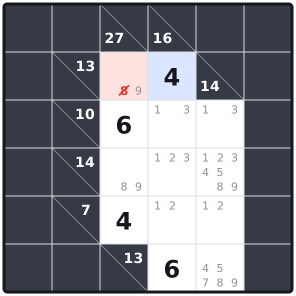
2. Naked single
When the crossing runs leave a square one possible digit, that's the answer.
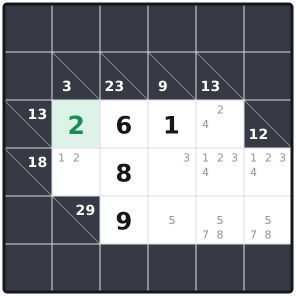
3. Must have
If every set that makes a run needs a certain digit, and only one square in the run can still take it, it goes there.
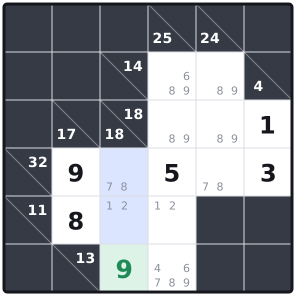
4. Run logic
Try every way to place a set in a run with the digits its squares can still hold. A digit that no arrangement puts in a square can be crossed off — for example 2 squares making 10 where one square can only be 1, 2 or 3: the other must be 9, 8 or 7.
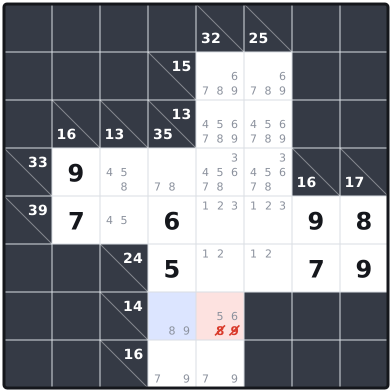
5. What if
Now and then on the biggest boards, try a candidate in a square with two or three options and follow the runs on from there. If some run can no longer be filled, the candidate was wrong.
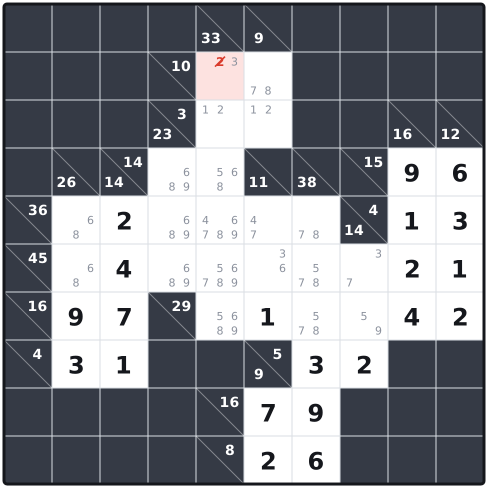
Difficulty that adapts to you
There are no levels to unlock. Every finished puzzle updates your rating — clean, hint-free wins count most — and the next puzzle is chosen around it, with the odd easier breather and harder stretch.
| Tier | Board | What it takes |
|---|---|---|
| Easy | 6×6 | Sum combos and singles |
| Medium | 7×7 | Sum combos, singles and must-haves |
| Hard | 8×8 | A few steps of run logic |
| Expert | 9×9 | Plenty of run logic |
| Master | 10×10 | Long chains of run logic, now and then a what-if |
| Extreme | 10×12 | The longest chains on the biggest boards |
Kakuro questions
What is Kakuro?
Kakuro, also called Cross Sums, is a number crossword. Instead of words you write digits from 1 to 9 into the white squares so that each across or down run adds up to the clue in the square before it, and no digit repeats within a run.
Can digits repeat in Kakuro?
Not within a run. The same digit can appear many times on the board, but never twice in the same across or down run.
Is there a daily limit?
No. There are 1,600 puzzles and you can play as many as you like, whenever you like, for free.
Can I play Kakuro offline?
Yes. After the first visit all puzzles are stored on your device, so it works with no connection. Add it to your home screen to use it like an app — here's how.
How does the difficulty work?
Kakuro adapts to you. Each finished puzzle updates a skill rating and the next puzzle is picked around it, from Easy 6×6 boards that fall to digit combinations alone up to Extreme 10×12 boards with long chains of run logic.