 Gooby
Gooby
Unruly: two colours, never three in a row
Fill the grid with blue and orange so that no three of a colour line up and every row and column is half and half. A calm binary puzzle — also known as Takuzu or Binairo — with 1,600 puzzles from 6×6 to 12×12, no ads and no sign-up.

How to play Unruly
The board is a square grid with an even number of rows. A few cells start filled in; colour every other cell blue or orange so that:
- No three cells in a row — across or down — have the same colour.
- Every row and every column has as many blue cells as orange ones.
That's all. Every puzzle has exactly one solution and can be solved by logic alone, no guessing. The rules come from Simon Tatham's Unruly; the same idea is known as Takuzu, Binairo or simply the binary puzzle.
Controls
- Pick a colour at the bottom of the screen, then tap a cell to fill it. Tap it again to clear it.
- Press and hold a cell to fill it with the other colour — no need to switch.
- Drag across empty cells to fill a whole run at once.
- Cells with a small dot were given and can't change. Turn on line counters in the game settings to see how many of each colour every row and column still needs.
Unruly strategy: six techniques
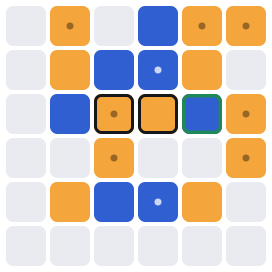
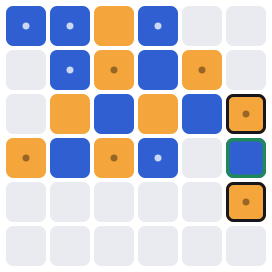
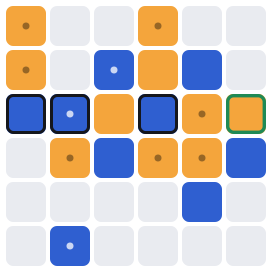
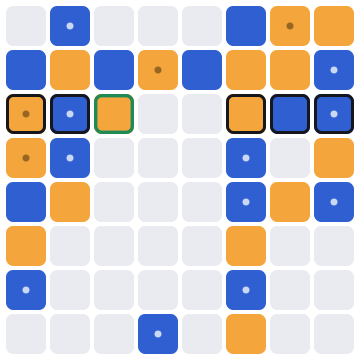
These are the techniques our hints use, from easiest to hardest, each on a real position from the game. The ringed cells are the pattern; the green ring is the cell it fills.
1. Pair
Two cells of the same colour side by side: the cells at both ends must be the other colour, or there would be three in a row.
2. Sandwich
Two cells of the same colour with one gap between them: the gap must be the other colour.
3. Half Full
Once a row or column has half its cells in one colour — three on a 6×6, four on an 8×8 — every other cell in it is the other colour.
4. Last One
When a line needs just one more of a colour, try each open spot for it. Some spots would leave three of the other colour together somewhere else in the line — so the last one can't go there, and those cells take the other colour.
5. Line Scan
The general form of Last One. Count what a line still needs and list the ways to fit it without three in a row. If every way agrees on a cell, that cell is decided. On harder boards this is the workhorse.
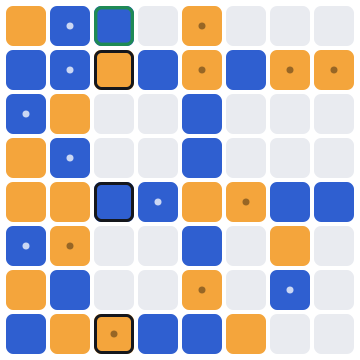
6. Contradiction
Pick a cell and imagine it one colour. Follow the simple techniques from there; if some line ends up impossible to fill, the cell must be the other colour. Expert puzzles need a few of these, Extreme ones many.
Difficulty that adapts to you
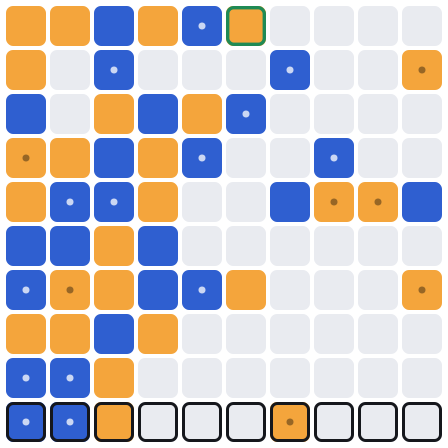
There are no levels to unlock. Every finished puzzle updates your rating — clean, hint-free wins count most and a lost game lowers it — and the next puzzle is chosen around your rating, with the odd easier breather and harder stretch.
| Tier | Boards | What it takes |
|---|---|---|
| Easy | 6×6 – 8×8 | Pairs, Sandwiches and Half Full lines |
| Medium | 8×8 – 10×10 | A few Last One or Line Scan steps |
| Hard | 10×10 – 12×12 | Many Line Scans |
| Expert | 10×10 – 12×12 | One to three Contradictions |
| Master | 12×12 | Four to eight Contradictions |
| Extreme | 12×12 | Long runs of what-ifs |
Unruly questions
Is Unruly the same as Takuzu or Binairo?
Nearly. Takuzu and Binairo use the same two rules — no three in a row, and every row and column half one colour, half the other — and usually add a third rule that no two rows or columns may be identical. Unruly, like Simon Tatham's puzzle of the same name, leaves that third rule out, and every puzzle still has exactly one solution.
Is there a daily limit?
No. There are 1,600 puzzles and you can play as many as you like, whenever you like, for free.
Can I play Unruly offline?
Yes. After the first visit all puzzles are stored on your device, so it works with no connection. Add it to your home screen to use it like an app — here's how.
How does the difficulty work?
Unruly adapts to you. Each finished puzzle updates a skill rating, and the next puzzle is picked around it, from Easy 6×6 boards up to Extreme 12×12 boards that need several what-if deductions.