 Gooby
Gooby
Cagey: a maths puzzle where every cage adds up
Fill the grid so no number repeats in a row or column, and the numbers in every outlined cage make its target — add, subtract, multiply or divide. A KenKen-style puzzle, also known as Calcudoku or Mathdoku, with 1,600 puzzles from 4×4 to 9×9, no ads and no sign-up.

How to play Cagey
The board is a square grid, 4×4 up to 9×9, divided into cages — groups of squares with a thick outline and a clue in the corner. Fill every square with a number from 1 to the size of the grid so that:
- Every row and every column holds each number exactly once.
- The numbers in each cage make its target with its operation: 12+ adds up to 12, 24× multiplies to 24.
- − and ÷ cages always hold two numbers: the bigger one minus, or divided by, the smaller (3− could be 1 and 4; 2÷ could be 3 and 6).
A cage of one square simply shows its number, and those start filled in. A number may repeat inside a cage as long as the copies are not in the same row or column. Every puzzle has exactly one solution and can be solved by logic alone — no guessing.
Controls
- Tap a square, then a number at the bottom. Or tap a number first, then tap the squares it goes in.
- Switch on Notes to pencil in candidates. In Notes mode, press and hold a number to set it as the answer.
- A full cage that misses its target gets a red outline, so slips show up straight away (you can turn this off in the game settings).
Cagey strategy: six techniques
These are the techniques the hints use, from easiest to hardest, each on a real position from the game. Small numbers are the candidates still possible in a square.
1. Cage maths
List the ways a cage can make its target. On a 4×4 grid, 2− can only be 1 and 3 or 2 and 4; 7+ in two squares can only be 3 and 4. Whatever no way uses is out. This is the step that starts every puzzle.
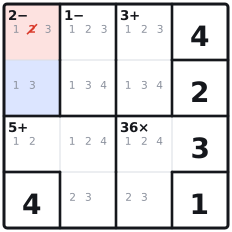
2. Naked single
When cage maths and the numbers already placed in a square's row and column leave it one possible number, that's the answer.
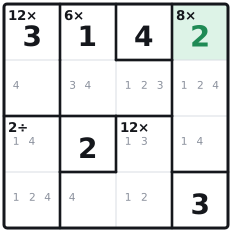
3. Hidden single
Look at it the other way round: if a number has only one square left in a row or column, it goes there — even when that square still has other candidates.
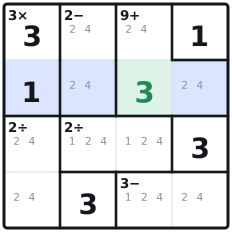
4. Naked subset
Two squares in a line that can only hold the same two numbers (or three squares sharing three) use those numbers up. No other square in that row or column can have them.
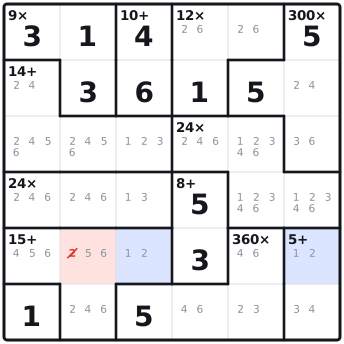
5. Cage line
Sometimes every way of making a cage uses a certain number, and all the squares where it could go lie in one row or column. The cage claims that number for the line, so it can be crossed off everywhere else in it.
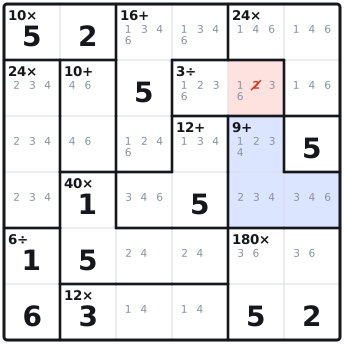
6. What if
On the biggest grids, try a candidate in a square with two or three options and follow the simpler techniques from there. If some square, line or cage runs out of options, the candidate was wrong. Master puzzles need one or two of these; Extreme ones more.
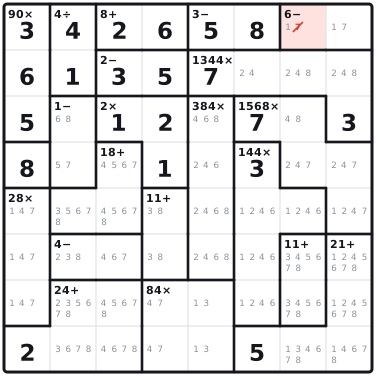
Difficulty that adapts to you
There are no levels to unlock. Every finished puzzle updates your rating — clean, hint-free wins count most — and the next puzzle is chosen around it, with the odd easier breather and harder stretch.
| Tier | Grid | What it takes |
|---|---|---|
| Easy | 4×4 | Cage maths and singles |
| Medium | 5×5 | Cage maths and singles |
| Hard | 6×6 | One to three naked subsets or cage lines |
| Expert | 7×7 | Several subsets and cage lines |
| Master | 8×8 | A what-if or two, or many cage lines |
| Extreme | 9×9 | What-if reasoning |
Cagey questions
Is Cagey the same as KenKen?
It plays by the same rules. KenKen is a trademarked name for this kind of puzzle; the same idea is also called Calcudoku, Mathdoku, Kendoku or Keen. Cagey is Gooby's free version: fill the grid with 1 to n, no repeats in any row or column, and make every cage's target with its operation.
Can a number repeat inside a cage?
Yes, as long as the two squares are not in the same row or column. An L-shaped 4× cage on a 4×4 board can be 1, 4, 1 if the two 1s sit in different rows and columns.
Is there a daily limit?
No. There are 1,600 puzzles and you can play as many as you like, whenever you like, for free.
Can I play Cagey offline?
Yes. After the first visit all puzzles are stored on your device, so it works with no connection. Add it to your home screen to use it like an app — here's how.
How does the difficulty work?
Cagey adapts to you. Each finished puzzle updates a skill rating and the next puzzle is picked around it, from Easy 4×4 grids that fall to cage maths alone up to Extreme 9×9 grids that need what-if reasoning.
KenKen® is a registered trademark of Nextoy, LLC. Gooby is not affiliated with or endorsed by Nextoy.